
Start with how you cook
The best countertop is the one that suits the way you live. A family that cooks every night, sets down hot pans and spills lemon juice needs a different surface than a couple who mostly entertain. Before you fall for a slab, think about five things. How much heat it will see, how much chopping and sliding happens on it, what spills it will meet, how much care you are willing to give it, and whether a little wear will bother you or charm you.
The quick comparison
| Material | Heat | Scratches | Stains and etching | Upkeep | Price |
|---|---|---|---|---|---|
| Quartz | Use trivets | Very good | Very good | Very low | $$ to $$$ |
| Granite | Very good | Very good | Good when sealed | Low | $$ to $$$ |
| Quartzite | Very good | Excellent | Good when sealed | Low | $$$ to $$$$ |
| Marble | Good | Fair | Etches with acids | High | $$$ to $$$$ |
| Porcelain slab | Excellent | Excellent | Excellent | Very low | $$$ |
| Soapstone | Excellent | Scratches easily | Will not etch | Medium | $$$ |
| Butcher block | Poor | Marks easily | Stains | Medium to high | $ to $$ |
| Solid surface | Poor | Fair, repairable | Good | Low | $$ |
| Laminate | Poor | Fair | Good | Low | $ |
| Stainless steel | Excellent | Scratches to a patina | Excellent | Low | $$$ |
Prices are relative and depend on the slab, thickness, edge details and local fabrication costs.
Quartz
Quartz countertops are engineered. Crushed natural quartz is bound with resin and pigment into slabs, which gives them consistent colour and pattern, a non-porous surface that does not need sealing, and very good resistance to stains and scratches. That is why quartz has been the most popular choice in many kitchens for the past decade.
The resin is its weak point. A very hot pan straight from the oven can scorch or crack it, so trivets are a must, and strong sunlight can slowly change the colour, which rules quartz out for most outdoor kitchens. Cutting and polishing engineered stone also releases silica dust that is dangerous to the workers who fabricate it, and Australia banned engineered stone from July 2024 for that reason. Many manufacturers now offer lower-silica products, and it is worth asking your fabricator how they control dust.
Granite
Granite is a natural igneous stone, hard and heat tolerant, with a huge range of colours from speckled to dramatic movement. Most granites are fairly dense, but they are still natural stone and benefit from a penetrating sealer, more often for lighter, more porous varieties. Dark, honed granite shows water spots and fingerprints more than polished. Granite was the defining countertop of the 2000s, and while trends have moved on, a well-chosen slab still looks good and lasts for decades.
Quartzite
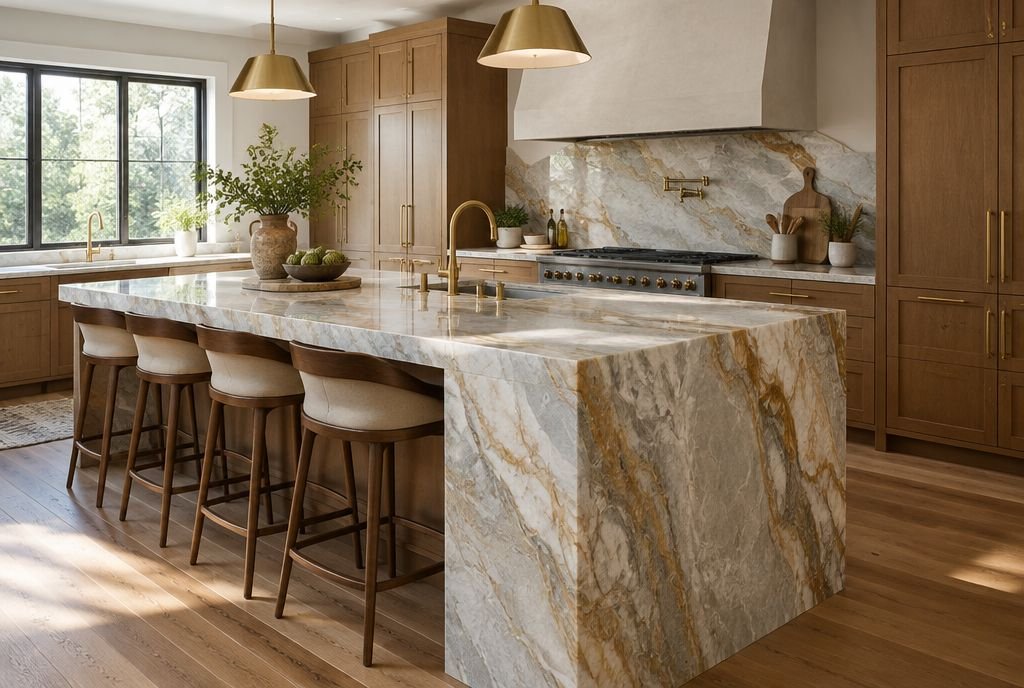
Quartzite is natural sandstone that heat and pressure turned into a very hard stone, about 7 on the Mohs hardness scale. Many quartzites have the soft white and grey veining people love in marble, with far better resistance to scratching and acids. That combination makes it one of the most sought-after luxury surfaces today.
One caution matters a lot. Some stones sold as quartzite are really marble or dolomite, which are softer and etch. Before you buy, ask to test a sample. A true quartzite will scratch glass and will not dull when you leave lemon juice on it for a few minutes. Quartzite still benefits from sealing, and its hardness makes fabrication slower and more expensive.
Marble
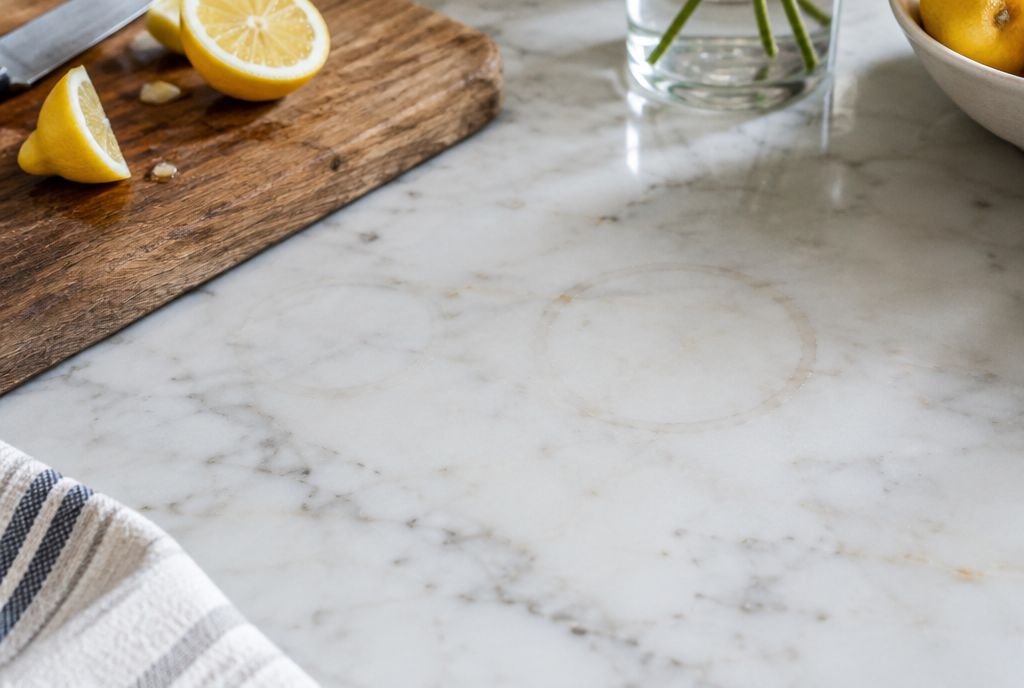
Marble is the classic baking surface, cool to the touch and endlessly beautiful. It is also soft, about 3 on the Mohs scale, and made of calcite, which reacts with acids. Lemon juice, wine, tomato and vinegar leave dull marks called etches, and sealing does not prevent them because sealers only slow staining. Many European kitchens embrace this, treating the patina as part of the character.
If you love marble but not the marks, choose a honed finish, which hides etching far better than polished, or use marble on a baking station or a bathroom vanity and something tougher where you cook.
Porcelain slab
Large porcelain slabs are made from fired clay and minerals, often only 12 mm thick. They resist heat, scratches, stains and UV light extremely well, which makes them one of the few surfaces that work indoors and out. The pattern can be printed to look like marble, concrete or stone.
Because the pattern is usually on the surface, a chip shows the body underneath, and the hard, thin material needs careful handling and an experienced fabricator. Edge profiles are limited compared with stone, and mitred edges are used to make thin slabs look thicker.
Soapstone
Soapstone is a soft, dense natural stone with a velvety feel, usually charcoal grey with subtle veins. It is chemically inert, so acids will not etch it, and it handles heat beautifully. It does scratch and dent, but light scratches can be sanded out or blended with mineral oil, which also darkens the stone to a deep, even colour. People who choose soapstone tend to love its aged, lived-in look.
Butcher block and wood
Wood counters bring warmth no stone can match and feel good to work on. They need regular oiling, they mark and stain, and they should be kept away from the wettest areas, though a well-sealed wood island can last for decades. The upside is that wood can be sanded and refinished. Edge-grain and end-grain construction are tougher than face-grain planks.
Solid surface, laminate and stainless steel
Solid surface materials such as Corian are acrylic-based, seamless and repairable, and they allow sinks moulded right into the counter. They do not like heat and scratch more easily than stone. Modern laminate is far better than the laminate of the 1980s, with realistic patterns and thin edges, and it remains the most affordable choice, though it cannot be cut on or repaired well. Stainless steel is what professional kitchens use. It is hygienic and heatproof, and it scratches into a soft patina that some people love and others cannot stand.
Thickness, edges and seams
- Most stone and quartz comes in 2 cm (about 3/4 in) or 3 cm (about 1 1/4 in) thickness. Thicker looks heavier and needs less support.
- Edge profiles range from a simple eased edge to bevels, bullnose and ogee. Simple edges look more current and chip less.
- Long runs and big islands may need seams. Ask where the fabricator plans to put them before you approve the layout.
- Waterfall ends and mitred edges make a statement but add cost and need careful vein matching.
- Overhangs for seating need hidden supports, especially with thinner materials.
Mixing materials
You do not need one material everywhere. A tough quartz or quartzite on the perimeter where you cook, with a marble or wood island where you gather, gives you beauty and practicality at once. Many designers pair a bold island with a quieter perimeter so the room does not feel busy.
Test before you choose
- Take samples home and look at them in your own light, morning and evening.
- Leave lemon juice, red wine, coffee and oil on a sample for an hour, then wipe it off.
- Set a hot mug on it, scratch it with a key and see how it looks afterwards.
- Ask to see the full slab, not just a sample, for natural stone.
- Ask your fabricator about sealing, care products and what the warranty covers.
Related guides
Planning the rest of the kitchen? Read our history of the kitchen for what lasts and what dates, our dimensions cheat sheet for counter heights and island clearances, and our guide to hard water and dry air if you live with hard water, which leaves marks on every surface. Our kitchen renovations page shows how Kay2 designs and builds kitchens.
Sources
Checked October 18, 2026. Programs and rules change; confirm current details with the source before you rely on them.
Talk it through with Kay2
Every project starts with a complimentary consultation with one of our estimators.