
The short answer
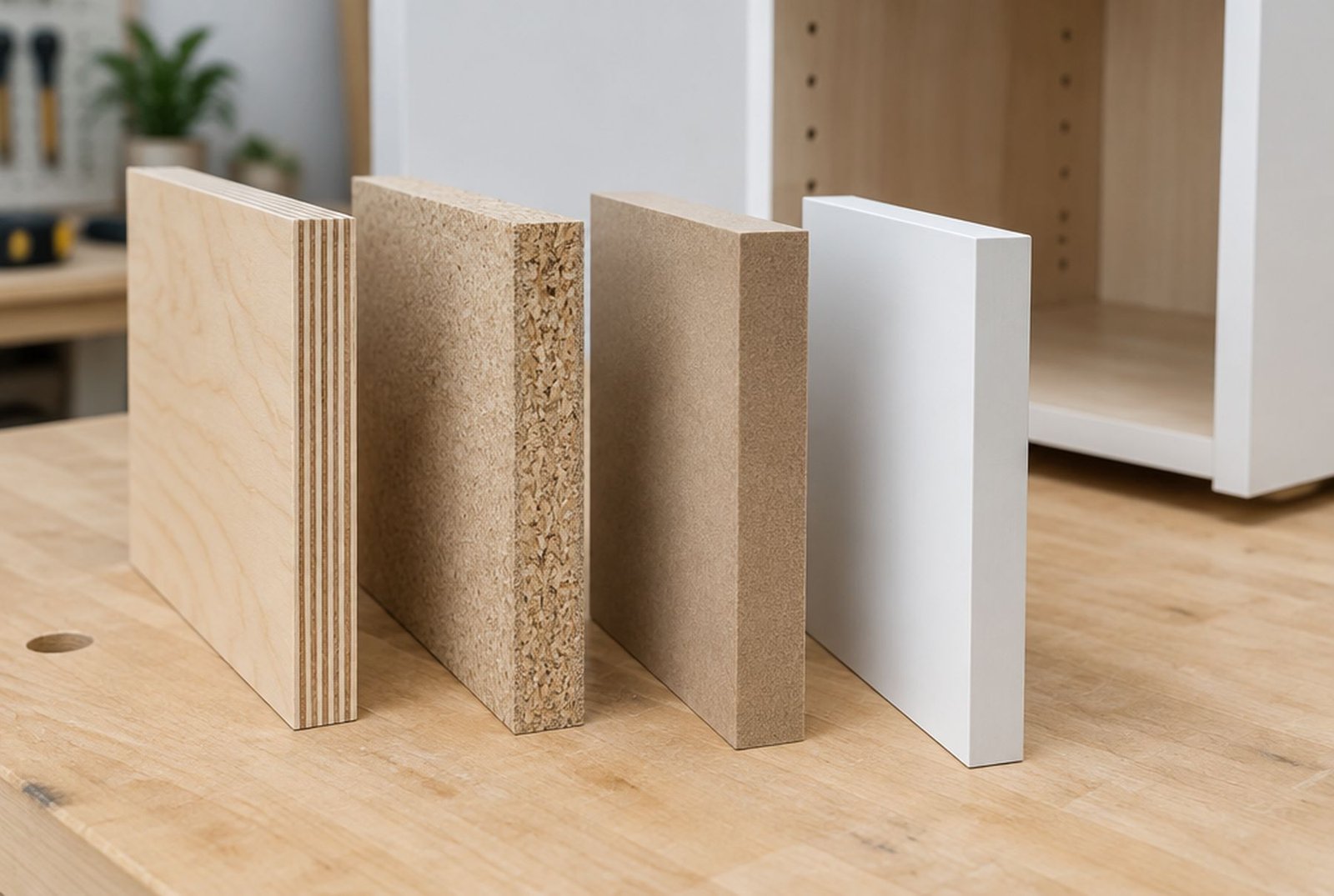
Most kitchen cabinets today are made from engineered wood panels, not solid wood. The box is usually particleboard or plywood, the doors are often MDF or solid wood frames, and the inside is covered with melamine or a wood veneer. Solid wood throughout is rare and, for boxes, not even better, because it moves with humidity.
It does matter, but less than people think. A well-made particleboard box with good edges, sturdy joints, quality hinges and full-extension drawers will outlast a plywood box with cheap hardware. Where the material really counts is near water, under the sink and beside the dishwasher, and in how the box holds screws for hinges over twenty years.
What the boxes are made of
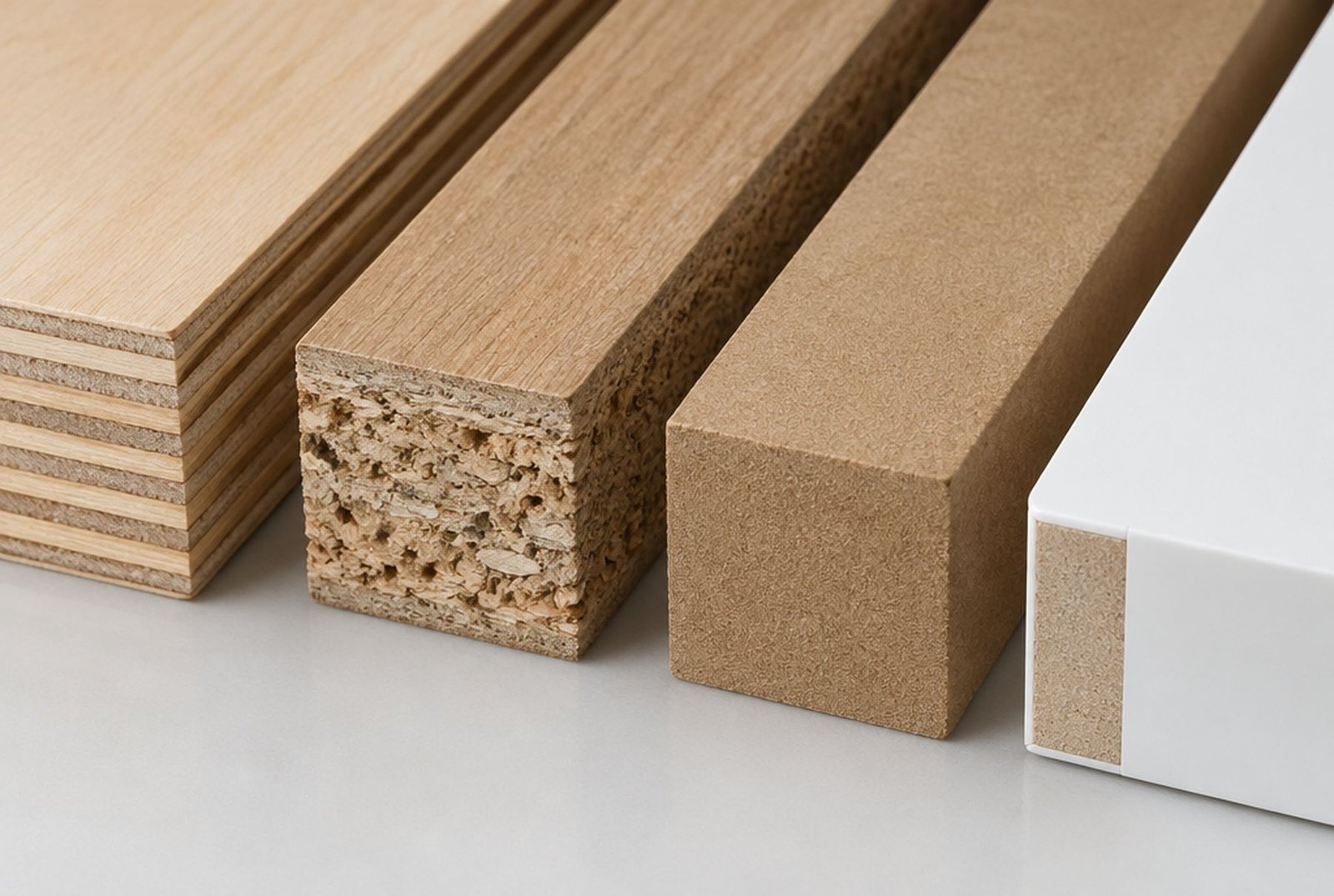
| Material | What it is | Strengths | Weaknesses |
|---|---|---|---|
| Plywood | Thin wood layers glued with the grain crossing | Strong, holds screws well, light, recovers better from small leaks | Costs more, edges show layers, quality varies a lot |
| Particleboard | Wood chips and glue pressed into a panel | Very flat and stable, inexpensive, takes a melamine face well | Swells permanently if water gets into an edge, heavy, weaker screw holding |
| MDF | Fine wood fibres and glue pressed into a dense panel | Smooth and stable, perfect for painted doors and routed profiles | Heavy, swells with water, not ideal for boxes |
| Melamine | A tough paper and resin skin bonded to particleboard or MDF | Easy to clean, durable inside surface, consistent colour | Chips at edges if poorly banded, water gets in at cut edges |
| Solid wood | Real boards | Beautiful for door frames, face frames and drawer boxes | Moves with humidity, so it is rarely used for whole boxes |
Melamine is a surface, not a core. When a salesperson says melamine cabinets, they mean particleboard or MDF with a melamine face, which is what most frameless European-style cabinets use.
Plywood or particleboard, the real answer
Plywood is better at three things. It holds screws more strongly, it is lighter, and if a small leak wets it, it often dries out without swelling much. Particleboard is better at being perfectly flat and consistent, and it costs less.
For most of a kitchen, a good particleboard box with a thick melamine face and properly sealed edges is perfectly adequate and is what many high-end European cabinet makers use. Where we would push for plywood, or for a waterproof panel, is the sink base and the cabinets either side of the dishwasher, because that is where slow leaks happen. Some makers offer exactly that, plywood or moisture-resistant boxes only where water is a risk.
Box thickness matters too. Three-quarter inch sides are stiffer and hold hinges better than half-inch or five-eighths sides, especially on tall pantry cabinets.
Frameless or face-frame cabinets
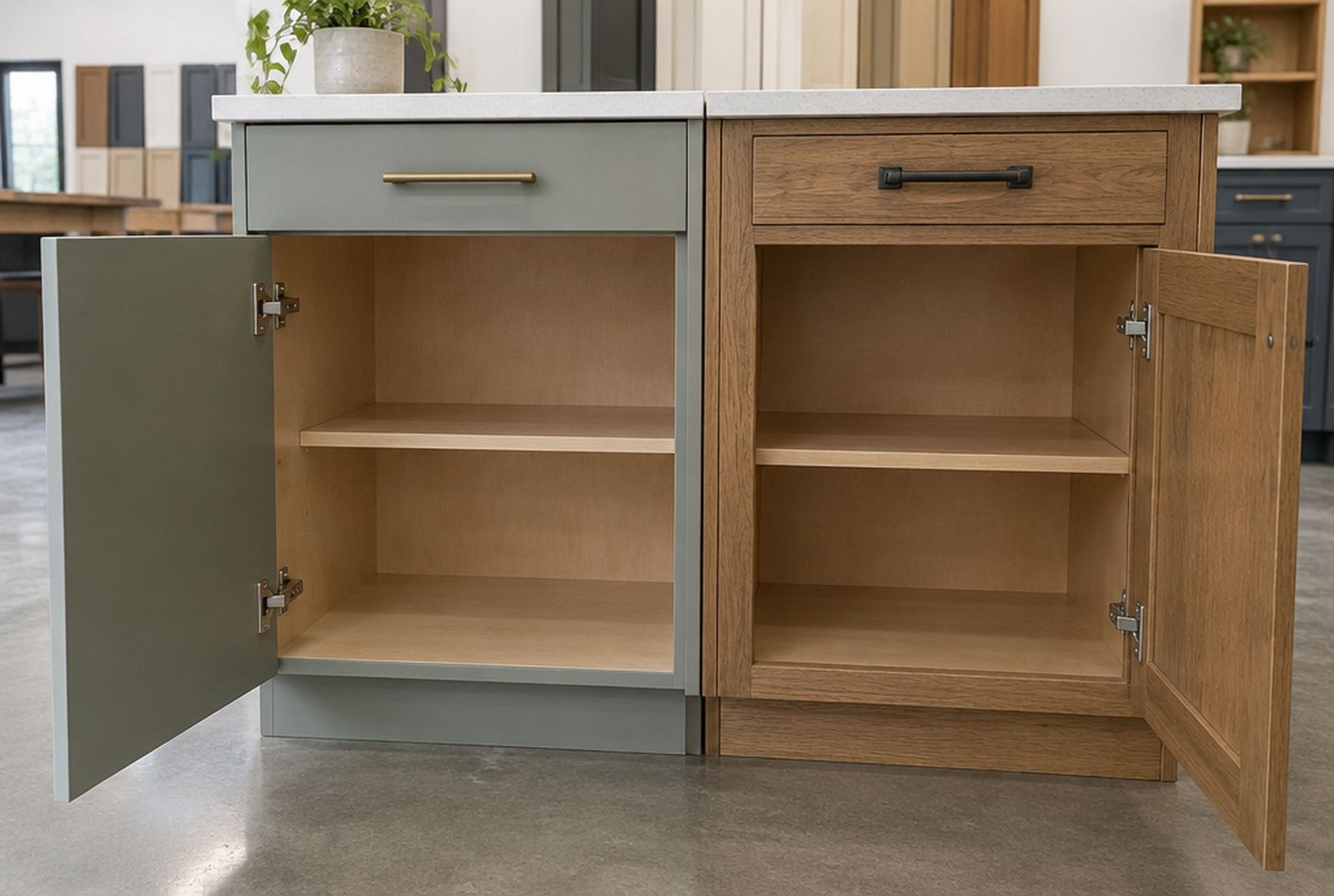
This is the other big construction choice, and it changes how a kitchen looks and works.
| Frameless (European style) | Face-frame (traditional North American) | |
|---|---|---|
| How it is built | The box sides are thick enough to hold the hinges, and doors cover the whole front | A solid wood frame is fixed to the front of the box, and the hinges attach to it |
| Storage | More usable space, with no frame narrowing drawers and openings | Slightly smaller openings and drawers |
| Look | Clean, modern, tight reveals between doors | Traditional, and the only way to do true inset doors |
| Strength | Depends on box material and thickness | The frame stiffens the box and gives a solid surface for installation |
| Installation | Needs flat, square walls and careful levelling | More forgiving of old, uneven walls |
Neither is better across the board. Frameless gives more storage and suits modern kitchens. Face-frame suits traditional and character homes, inset doors and walls that are not quite straight. Many custom shops build both.
Doors and finishes
- Painted doors are usually MDF, either as a one-piece routed door or a five-piece door with an MDF panel. MDF does not move with the seasons, so painted joints crack less than painted solid wood. In a dry winter climate, that matters.
- Stained wood doors are solid wood frames with a veneered or solid wood centre panel.
- Slab doors can be veneer, high-pressure laminate, lacquer, or melamine. Good laminate is very hard wearing.
- Thermofoil, a vinyl skin pressed over MDF, is inexpensive but can peel near heat sources such as ovens and toasters.
- Factory-applied finishes are tougher and more even than finishes brushed on site.
Drawers and hinges, where cheap cabinets give themselves away
Open the drawers before you look at the doors. Drawers take the most daily abuse, and they are where budget cabinets save money.
- Look for full-extension, soft-close drawer runners from a known hardware maker, rated for a decent load. Under-mount runners hide under the drawer and look cleaner.
- Drawer boxes should be solid wood with dovetail joints, or a quality metal drawer system. Stapled particleboard drawer boxes are the first thing to fail.
- Hinges should be adjustable in three directions and soft-close. Good hinges are what keep doors lined up for decades.
- Ask how the box is joined. Dowels or screws with glue, or a proper joinery system, are stronger than staples alone.
Formaldehyde and indoor air
Particleboard, MDF and hardwood plywood are made with glues that can release formaldehyde. In Canada, the Formaldehyde Emissions from Composite Wood Products Regulations came into force on January 7, 2023, and set emission limits and labelling for composite wood panels and finished goods sold in Canada, including furniture and cabinets. The United States has a similar national standard.
If indoor air is a priority, ask your cabinet maker which panels they use and whether they are certified to these limits or use no-added-formaldehyde boards. New kitchens smell of glue and finish for a while, and good ventilation in the first weeks helps.
Where to spend and where to save
| Worth paying for | Fine to save on |
|---|---|
| Moisture-resistant boxes at the sink and dishwasher | Plywood boxes for every upper cabinet |
| Full-extension, soft-close drawers from a good maker | Fancy inside finishes in cabinets you rarely open |
| Quality hinges | Exotic veneers on cabinet backs and interiors |
| Thicker box sides on tall cabinets | Custom sizes where standard widths fit the layout |
| Good edge banding on every exposed edge | Expensive door styles on a laundry room or garage |
Our guide on where to save and where to splurge in a renovation applies the same thinking to the rest of the house.
How to judge cabinets in a showroom
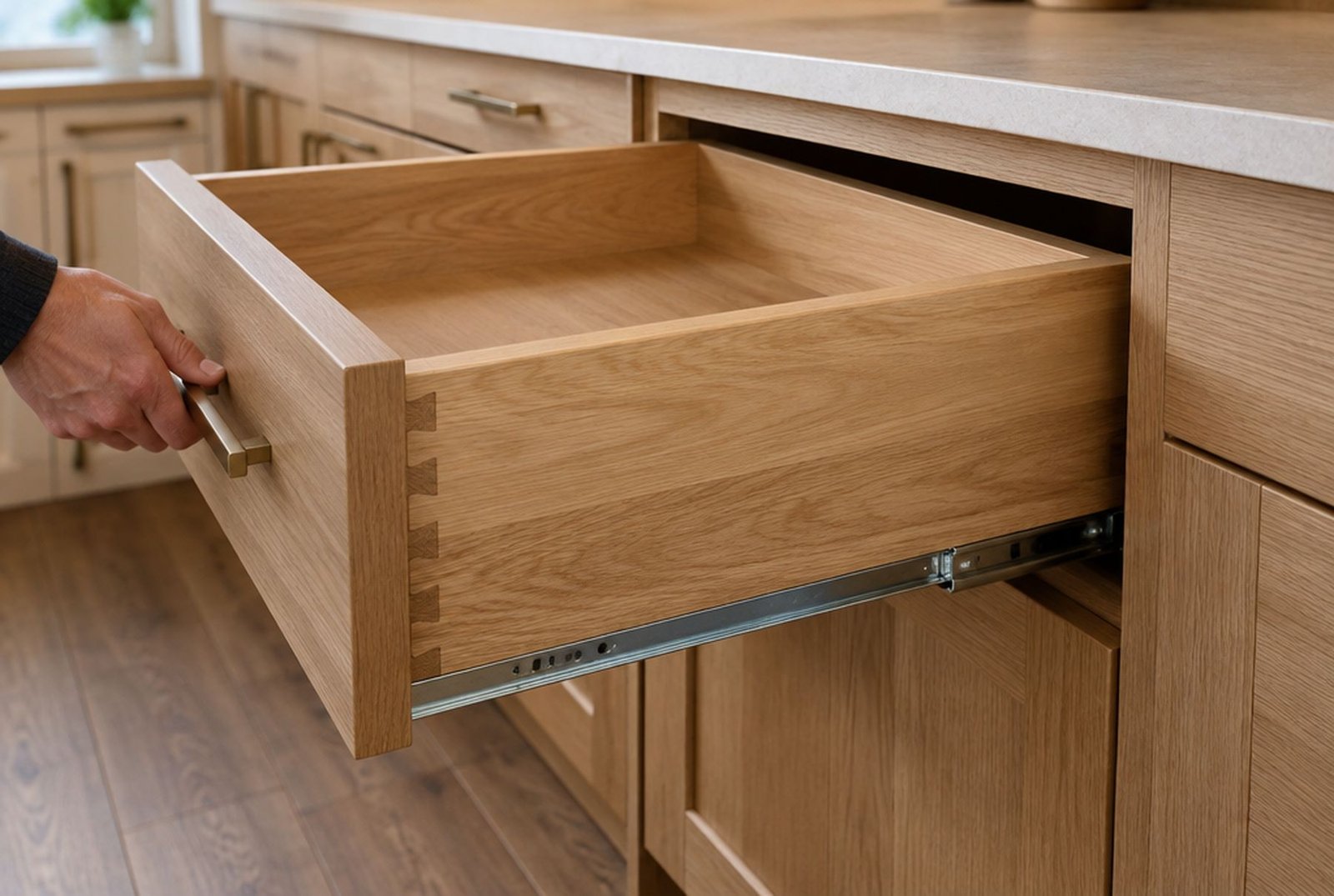
- Pull a drawer all the way out and push down on it. It should feel solid and close gently.
- Look at the cut edges inside the sink base and at the bottom of the doors. Every edge should be sealed with banding.
- Ask what the sink base is made of, and whether there is a protective liner.
- Ask how thick the box sides are, and how they are joined.
- Ask for the hinge and drawer hardware brand and its warranty.
- Ask what the warranty on the cabinets themselves covers, and for how long.
Stock, semi-custom and custom
Construction quality runs across every price level, but it tends to rise with the category. Stock cabinets come in fixed sizes and finishes. Semi-custom gives more sizes and options. Custom cabinets are built for your kitchen, in whatever material and construction you choose. Our guide to stock, semi-custom or custom cabinets goes through the trade-offs, and our guide on planning a kitchen layout covers how the boxes come together into a room.
Questions people ask
- Are particleboard cabinets bad? No. Good particleboard with a melamine face and sealed edges is used by many quality makers. Poorly banded, thin particleboard is the problem.
- Is MDF good for cabinet boxes? It is excellent for painted doors, but heavy and less ideal for boxes.
- Do plywood cabinets last longer? They handle leaks and screws better, but hardware and construction decide lifespan more than the core.
- Can old cabinets be refaced instead? Often, if the boxes are solid and the layout works. Our guide to updating oak kitchen cabinets covers the options.
How Kay2 approaches cabinets
In Calgary, Kay2's in-house design team plans each kitchen around how it will be used, and full kitchens and custom millwork are built by a trusted Calgary cabinet manufacturer, with our own shop handling smaller and more customized pieces. If you are in the area, see our kitchen renovations page or book a consultation.
Sources
- Government of Canada: Formaldehyde Emissions from Composite Wood Products Regulations factsheet
- Justice Laws Website: Formaldehyde Emissions from Composite Wood Products Regulations (SOR/2021-148)
- Health Canada: Formaldehyde
Checked November 12, 2026. Programs and rules change; confirm current details with the source before you rely on them.
Talk it through with Kay2
Every project starts with a complimentary consultation with one of our estimators.